












Rust tools: hatchets, pickaxes, and fast farming
Tools in Rust determine the pace of progression: a stone hatchet covers the first minutes, a metal pickaxe speeds up furnaces and doors, salvaged tools increase yield per trip, while chainsaw and jackhammer turn a short route into a large supply. But expensive tools make noise, require fuel or repairs, and attract players.
Why the right tool is more important than long farming
Two players on the same route get different results if one uses the starting rock and the other a specialized tool with bonus points. Efficiency affects not only the amount of resources but also the time spent away from the base. The faster the route is completed, the less chance of encountering an ambush.
The price of the tool should match the task. For a short reconnaissance, a jackhammer is not needed, and mining a large batch of sulfur with a stone pickaxe takes too long. Evaluate the volume, distance, and the ability to recover the item after death.
Starting Rock
The rock is given after spawning and gathers wood, ore, bodies, and individual objects. It is slow but does not require crafting. Use it only until you have materials for specialized stone tools.
Do not try to completely farm the forest with the starting rock. Gather the minimum for an axe, pickaxe, building plan, and sleeping bag. The step-by-step order is in the Rust beginner guide.
Stone Hatchet
Stone Hatchet is crafted from wood and stone without a workbench. It is suitable for the first trees, animals, and breaking weak objects. Keep one in your working kit and a second one at home if the team has not yet unlocked the metal tier.
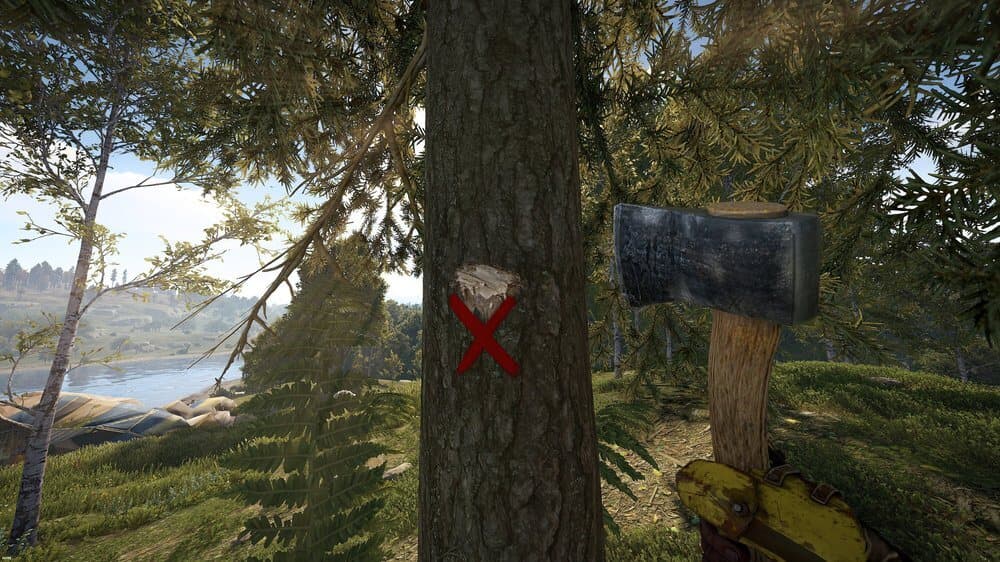
Hit the red mark on the tree: the bonus zone moves after each hit and increases gathering. Stand so you can see the surroundings between swings. A farmer who constantly looks only at the tree becomes an easy target.
Stone Pickaxe
Stone Pickaxe is the basic tool for stone, metal, and sulfur ore. It requires 200 wood and 100 stone to craft, no workbench needed. This is a necessary step towards furnaces and metal doors.
Watch for the glowing spot on the vein. Strikes on the weak spot speed up gathering and increase efficiency. Turn with the marker, but before the final blow, look around: the disappearance of the vein and sound signal your presence to others.
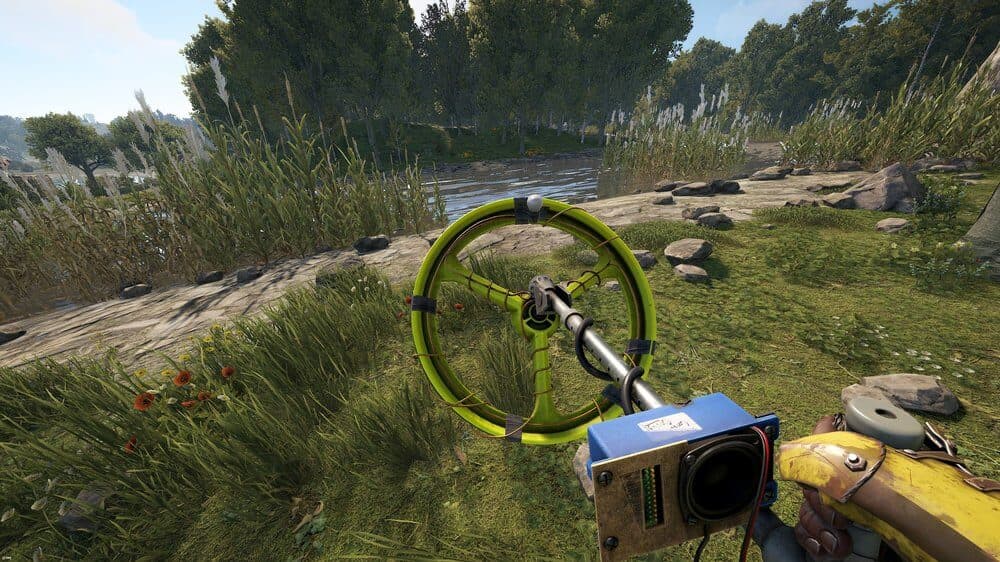
Metal Hatchet
Hatchet significantly speeds up wood gathering, requires the first workbench, and is crafted from 100 wood and 75 metal fragments. This is a good working tool for daily construction and furnaces.
Do not research the hatchet separately if the team is already progressing in the appropriate tech tree. Compare the cost of metal fragments and the possibility of finding the item in a crate. After unlocking, craft multiple copies immediately: the speed of development pays off the reserve.
Metal Pickaxe
Pickaxe gathers ore faster than the stone variant. To craft it, you need 125 metal fragments, 100 wood, and a first-level workbench. This is a predictable tool that is easy to produce in series.
Divide tasks in the group: one player goes for stone and metal, another gathers wood and components. Do not carry both best pairs on one person. If a farmer is killed, the team retains the ability to recover.
Salvaged Axe
Salvaged Axe is a high-performance hatchet that gathers more per hit but works slower than a regular hatchet. Crafting requires metal blades and a pipe, a second workbench. The tool is advantageous on a dense forest route.
Do not recycle all blades before deciding on crafting. Check the supplies according to the Rust components guide. If the forest is far and the route is dangerous, a cheaper hatchet may provide a better outcome for the evening.
Salvaged Icepick
Salvaged Icepick is a high-performance tool for ore with a large gather bonus. It is crafted from five blades and one pipe on the second workbench and quickly fills the inventory with stone, metal, and sulfur.
Gather a chain of veins with it, not just one rock near the base. Find in advance a fold in the terrain, a sleeping bag, and a return path. The cost of the tool is justified only if the mined resource regularly reaches home.
Jackhammer
Jackhammer is designed for ore veins and automatically destroys bonus points without precise aiming. It is not craftable or researchable, but can be obtained from loot and other in-game sources. The tool's supply is replenished at a workbench.
Speed comes with a loud noise. Do not start a vein on an exposed peak without checking the area. One player farms, the other watches. After several veins, return home: a full inventory and a jackhammer are too valuable for unnecessary risk.

Chainsaw
Chainsaw quickly gathers wood but requires low-grade fuel and creates a highly audible sound. Before heading out, check the supply, condition, and controls. Start the tool at the target, not in advance on the road.
Farm the forest in short series and change direction. A dense area hides the silhouette but limits visibility. Carry weapons, healing items, and a regular hatchet as a backup in case the fuel runs out.
Finding Advanced Tools
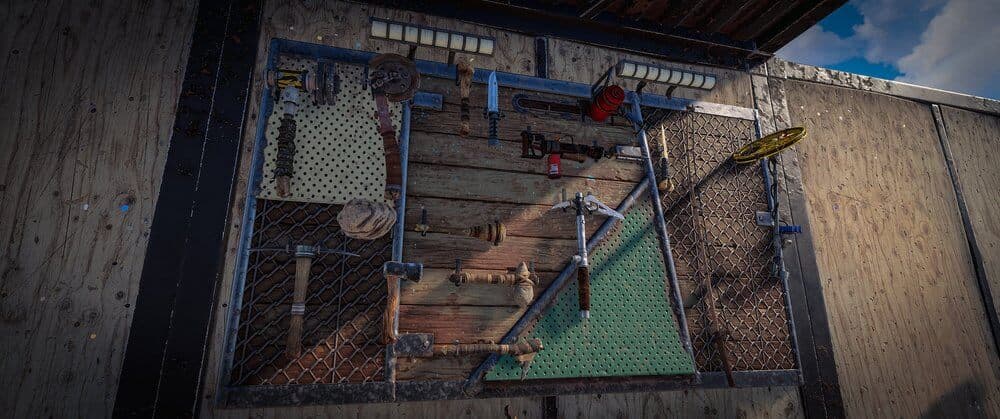
Hatchets and Pickaxes can be found in tool crates, salvaged variants in rarer loot, while jackhammers and chainsaws are available in valuable containers and other in-game locations.
Do not base your entire plan on a rare chance. A basic metal set can be crafted, so it should support the economy. The trophy speeds up the route but does not replace sustainable crafting.
Bonus Points for Wood and Ore
A red mark appears on trees, a bright spot on ore. Hitting them increases efficiency. The marker changes position, so move the crosshair after each strike. Jackhammer automatically uses weak ore points.
Do not sacrifice safety for the perfect bonus. If you hear footsteps, stop farming and take cover. A few missed strikes are cheaper than losing the tool and a full inventory.
Stone, Metal, and Sulfur
| Resource | Main Purpose | Priority |
|---|---|---|
| Stone | foundation, walls, maintenance | earliest volume |
| Metal Ore | fragments, doors, weapons | constant supply |
| Sulfur Ore | gunpowder and raiding | valuable but attracts risk |
| HQM | armor and advanced items | store securely |
Do not carry all sulfur in one trip. Divide batches and smelt in a secure area. Use the Rust raiding guide for attack planning.
Wood for Base and Fuel
Wood is used for construction, cupboard, boxes, charcoal, and many initial items. A large supply quickly diminishes after expansion. Create a permanent forest route but do not cut everything right next to the house: an empty circle reveals an active base.
Building priorities are listed in the Rust base building guide. Calculate the foundation and upkeep first, then gather the required volume with a small reserve.
Teas for Gathering Acceleration
Berry teas enhance wood or ore collection and make advanced tools even more efficient. The buff is beneficial when the route is prepared: there are several veins, transport, a safe path, and storage space. Drinking tea for just one wood is wasteful.
Check the recipes, levels, and organization of berries in the Rust mixing table guide. Monitor the duration of the effect and do not waste it on house sorting.
Transport for Farming
Horse, boat, and modular car increase the radius but create additional risks. Transport is audible, can be stolen, and a full cargo section concentrates all results in one point. Park discreetly and leave fuel for the return trip.
Assemblies and car protection are described in the modular cars guide. Before a big trip, drive the route empty and mark obstacles.
Farmer's Armor and Weapons
Expensive full metal armor raises the cost of loss, while a naked character easily dies from an animal or a single shot. The working compromise is clothing by biome, a medium-level helmet, a simple chest plate, medical items, and a weapon you know how to use.
Comparisons of sets are in the Rust armor guide, and weapon selection is in the Rust weapons guide. The farmer does not have to win every fight; their task is to notice the threat and retreat with resources.
Repair and Tool Condition
Monitor the gauge before heading out. A repair bench restores the item for resources but reduces maximum durability. Jackhammer replenishes at a workbench according to its mechanics. A broken tool in the middle of a route slows down and leaves the player far from home.
Keep a reserve of each mass tool. Do not repair a cheap stone pickaxe endlessly if it is easier to craft a new one. Service advanced items before they reach critical condition.
Solo Player Route
- Leave the best loot at home and prepare a sleeping bag.
- Take one specialized tool, weapon, and healing items.
- Walk a short circle around the base.
- Do not fill the inventory at all costs.
- Return via a different terrain feature.
- Immediately store resources and restore the kit.
Multiple short trips are more advantageous for solo play than one perfect run. It is harder for neighbors to predict the time and direction.
Group Organization
Appoint a farmer, guard, and driver. The guard does not walk close but controls the flank and height. Players share tools and resources so that one queue does not destroy all results. Voice commands should be brief: direction, distance, cover.
After returning, no one stands at an open door with a full inventory. First, close the airlock, then distribute resources among furnaces, TC, and storage. On PROSTOY RUST servers, consider the group limit and rules of the chosen mode.
Common Mistakes
- farming with the starting rock longer than necessary;
- ignoring bonus points;
- using jackhammer without observation on an exposed hill;
- chainsaw without fuel or spare hatchet;
- all tools and resources on one player;
- long direct route home;
- full inventory without space for important loot.
The speed of the tool becomes an advantage only with safe logistics. Improve not just one item but the entire chain: route, bonus points, protection, transport, storage, and recovery after loss.
Calculating Tool Payback
Compare the cost of crafting or purchasing with the additional resource per one safe route. If a salvaged tool allows you to finish work earlier and return before neighbors appear, its benefit lies not only in quantity. If you lose it every time on a distant hill, a cheap metal pickaxe is more efficient for your situation.
Consider repair, fuel, and delivery time. Chainsaw without low grade, jackhammer far from a workbench, and nearly broken icepick have hidden costs. The team can assign one expensive set to the main farmer and leave mass tools for others.
Storage and Smelting After a Trip
Upon return, first close the airlock, then distribute wood to TC and building box, ore to furnaces, sulfur to secure storage. Do not leave a full inventory on a sleeping character. Immediately replenish healing items, fuel, and tool condition for the next outing.
The furnace becomes a bottleneck: fast farming is useless if ore lies unprocessed for weeks. Distribute batches, do not show activity of all furnaces simultaneously, and move finished metal deeper into the base. Sustainable processing completes the route just like the final strike on a vein.


Latest comments